Photo courtesy of Paducah Symphony Orchestra.
This story was originally published in the March/April 2025 edition of Paducah Life Magazine.
Click here to read the original publication.
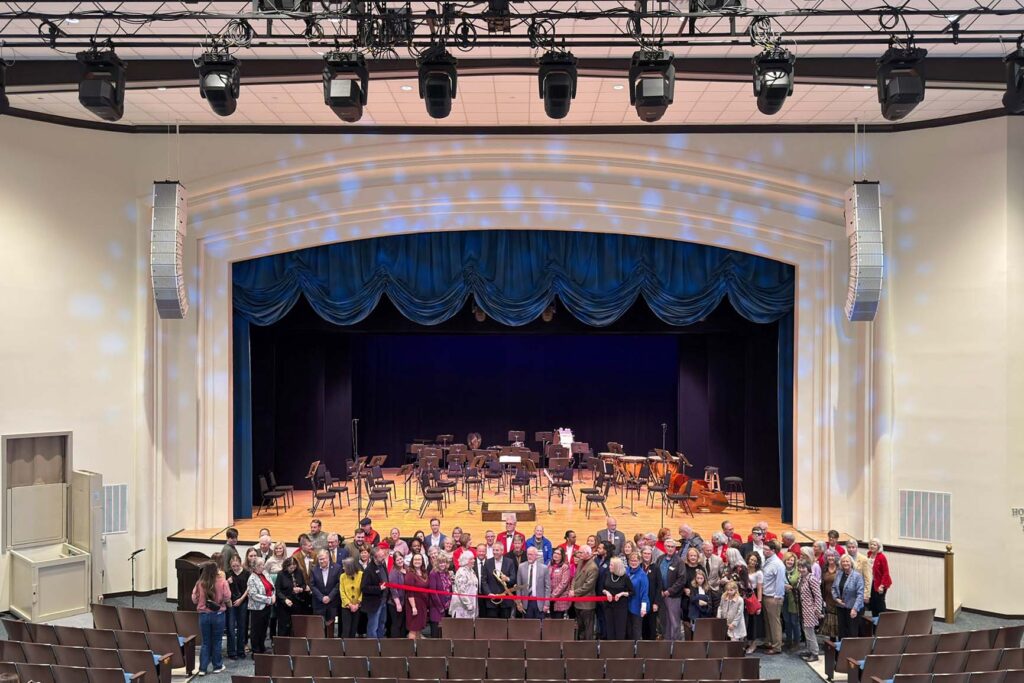
For the first time in many years, the streets that surround the former Walter C. Jetton Middle School filled with vehicles and anticipation. Through the dark, the strolling-paced clacks of high heels and dress shoes hitting the concrete sidewalks blend with the anticipatory conversations of patrons as they approach the (enter name of performance hall). The glow of amber accent lights that line the lobby’s ceiling shine through the classic transom-style windows, showcasing the historical venue merging with new, state-of-the-art technology as patrons enter below for the grand opening concert. It’s a milestone moment for Paducah Symphony Orchestra and opens doors for new possibilities in Paducah’s arts and music scene.
While opening night was a sight & sound to behold as the symphony came to life at Maestro Raffaele Ponti’s direction, Paducah Symphony Orchestra’s re-opening weekend was an eventful few days that brought a renewed sense of arts participation. This included Paducah Singer’s Sunday concert, Where The Spirit Flows, that featured a newly commissioned choral piece, Music in the Soft Air.
Paducah Singers is the region’s only professional choral ensemble co-founded by Fowler & Emily Yocum Black, Natalie Krupansky, and the late Art Deweese. “After [Art] retired, he wanted to bring together folks who still had the chops to do some music that not everyone could do,” shared Fowler Black, co-founder and treasurer of Paducah Singers. “We wanted to provide Paducah with as high a quality choral experience as possible.” Now in their 8th year, Paducah Singers has provided free or low cost choral concerts at various venues throughout the city.The ensemble, now directed by Dr. Susan Davenport, is a resident company at the Paducah Symphony Orchestra. Most of their programming has consisted of performing classic or newly published works. Their March 2025 concert opened up a new opportunity; a newly commissioned work created for the Paducah Singers to premiere.
Commissioned in memory of Gerry & Wally Montgomery by their three children, Music in the Soft Air is an ode to Paducah’s rich history, highlighting the music of the roustabout river workers that was collected by Mary Wheeler and cultural landmarks such as the Hotel Metropolitan and Washington Street Baptist Church. The 8 movement choral piece was created by composer William Averitt and librettist Robert Bode. Both Averitt and Bode visited Paducah for their initial research. It was Bode’s first time visiting Paducah but, for Averitt, it was a homecoming. Averitt is Paducah native who attended & graduated from the Walter C. Jetton Middle School. Averitt and Bode were in attendance at the premiere concert.
“It’s so great to be home and to be part of this wonderful, wonderful celebration,” Averitt shared with the audience before the presentation of Music in the Soft Air. “The river is so formative—that’s why the town is here.” Averitt shared that the first three movements refer to the river and its influence on Paducah history; the importance of the confluence of the Ohio & Tennessee Rivers, the heritage of the roustabout river workers, and the notable 1937 flood. The other five pieces reflect on the history of iconic infrastructure & locations, including the Illinois Central Line railroad, the Irvin Cobb Hotel, The Hotel Metropolitan, and Washington Street Baptist Church.
The commissioned work features a blend of powerful poetry, transient text-painting highlighted with powerful vocals from the ensemble and scoring that highlights the musical history of Paducah. “I always think of poems as being like pictures—and the music I write is a bit like a frame around the picture,” Averitt shared. “You try to use the right frame to set off the picture so that it looks its best.”
The future of the piece now rests with the Paducah Singers. While they are hoping to see it published for other professional choral ensembles to perform, Black notes that they intend to make it a part of their repertoire. “If it gets published, that just gives it extra credibility. But if it doesn’t, it’s not going to change our use of it,” Black expressed. “As Paducah makes strides in certain areas, we’d love to sing some of these pieces alongside other local rebirths,” noting PSO’s new venue and the continued renovations at the Columbia Art House. For now, Music in the Soft Air has made its presence known and, as shared by Black right before the first movement began, it’s great to hear “new notes for old walls.”
Who were the roustabouts?
The roustabouts were a collection of Black male river workers from the late 1800s to the early 1900s. From loading & carrying cargo up steep muddy hills to operating river locks and docking barges & ships as deckhands, the roustabouts were the laborers of the river who lived on the banks of river towns such as Paducah. These individuals endured low wages and poor working & living conditions that the river industry profited from. During the 1930s, Mary Wheeler, a musicologist from Paducah, traveled the Ohio River to document the songs of the roustabouts after noticing the decline of river life. In 1939, Wheeler published her book, Roustabout Songs: A Collection of Ohio River Valley Songs, that documented the songs & culture along the Ohio River. The Mary Wheeler collection, an archive of 9 cubic feet of folk songs, notebooks, and photographs donated by the family of Mary Wheeler, is available for viewing at the McCracken County Public Library’s public archives.